martedì 7 maggio 2013

The colours of Vajra, and an unexpected Barbera d'Alba Superiore 2009.

Above, side by side, the soft colours of Nebbiolo (left) against the intensely dark purple  Barbera (right)

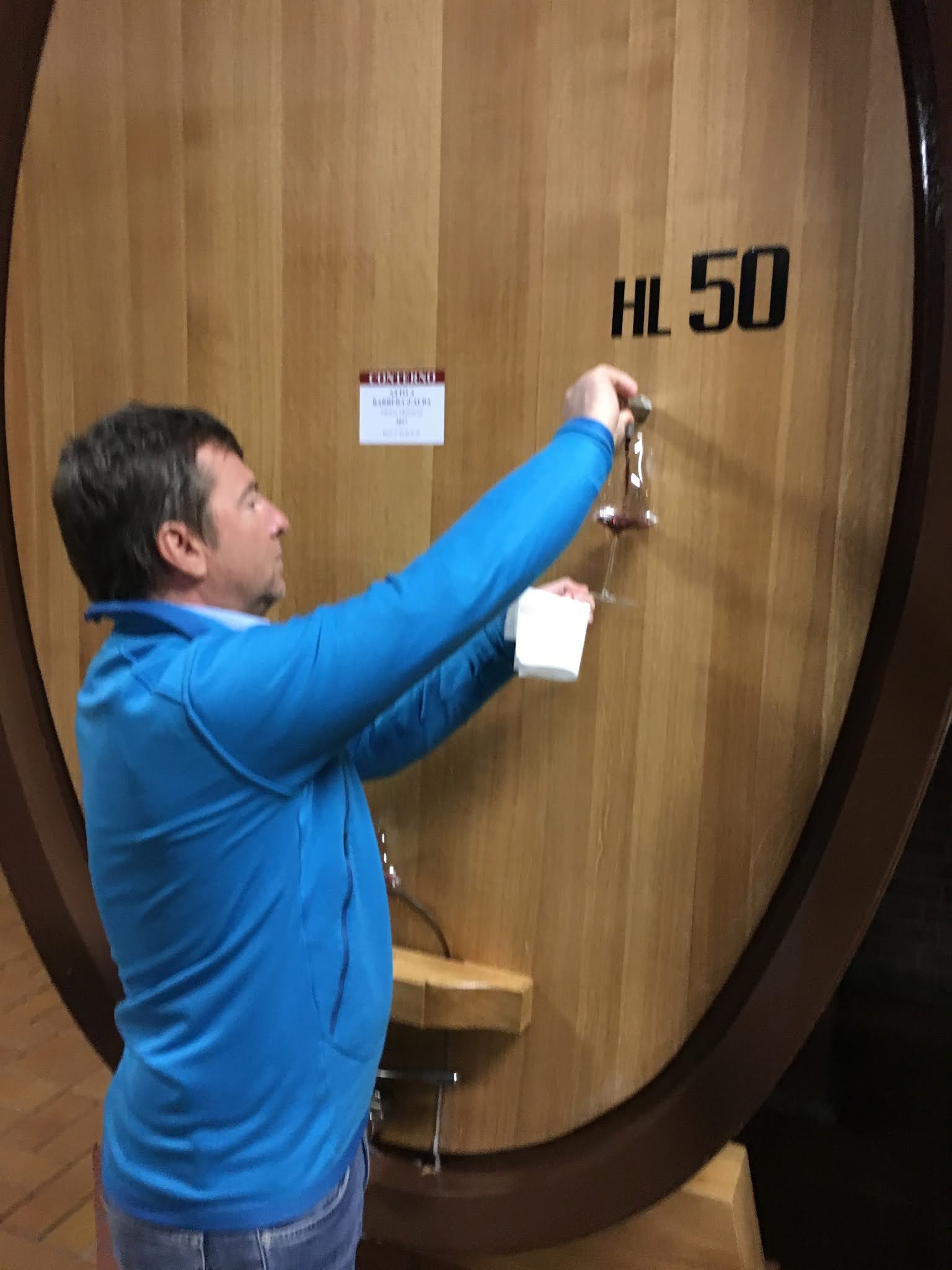
I had a brief stop and chat with Giuseppe Vaira in New York City last week and I managed to sample a couple of his wines right after he rushed out the door in typical New York Fashion.  Having the night off, I actually brought these two bottles home with me: a 2008 Barolo Albe, and a 2009 Barbera d'Alba Superiore.  The pleasant Barolo Albe coming from three vineyards, Le coste, Fossati and La Volta is usually a leaner, approachable style of Barolo but still with those traditional Nebbiolo notes you love.

I poured some of the Barbera Superiore into my glass and my only immediate reaction was a "Holy shit!''.  This is definitely a bold and intense expression of Barbera which seems to coat your mouth in a syrupy fashion. This Barbera is not playing games, just kicking asses and taking names. I have tasted many of the these wines on different occasions, but the 2009 Barbera in my glass seemed to be showing outside of the Vajra style I was used to.  Giuseppe was already flying back to his new daughter, so I threw an E-mail to his sister Francesca Vaira, who I happened to meet two years ago in Rome

Francesca explains that the Barbera d'Alba Superiore starts with the vineyard, the criteria being the vines that work the hardest to produce the best fruit.  The vines are either coming from the oldest vineyards or those from the poorest soils.  This selection produces natural yields year after year. 2009 was also a hot and dry year preceded by a very snowy winter, an ideal condition for the correct development of the vines.

''Denso sì,  di una densità dovuta all’annata e alle viti, 
non certo alla lavorazione in cantina.''

The most important thing to note is that this very concentrated and ripe Barbera is an expression of the selected vineyards and vintage, and not that of the work/vinification techniques used in the cellars.

Thank you Giuseppe and Francesca, always a pleasure to taste and learn about the wines of Vajra.


mercoledì 1 maggio 2013

L'humeur du temps 2011 Chablis


Domaine Alice et Olivier De Moor, 2011 Chablis l'Humeur du temps

Went for this wax top chablis today, that I have no knowledge of, and it turned out to be a fantastic purchase for around $26.  Enough so that I am writing about it right now.

Really beautiful citrus fruits bursting out, lemon pith, lime zest, gorgeous acidity, a whiff of turpentine and perfect minerality.

Biodynamic, Hand harvested, Fermentation in large oak barrels.

Here is a link to a quite extensive write up on the winery.

venerdì 26 aprile 2013

Sunset in Bushwick followed by a Smokin' 2008 Gevrey-Chambertin at Boulud

 Above, That spring feeling in the air with a rooftop spritz, Bushwick, Brooklyn.


Later, we dined at Bar Boulud which was a pretty memorable charcuterie experience.  Also happened to open two memorable wines.

Starting with a 2011 Chablis from Domaine Pattes Loup, who practice organic viticulture, we were sold on it as soon as Sommelier Eduardo described it as fresh, and like tapping a glacier.  It really brought a whole new style of freshness and acidity to chablis that I have never tasted.

The second bottle made its way to our table in the form of Philippe Livera, Domaine Des Tilleuls, Gevrey-Chambertin, Clos Village 2008.  After this bottle I am sold on 2008 red Burgundy, for however long it lasts the wines at village level from this vintage are really expressing themselves.

In 2005 Damien Livera started estate bottling his wines.  Since the 1930's his grandfather was selling the wines to the Beaune negocient houses.

This bottle was full of sharp toasty notes; like an enticing burnt match that slowly morphed into dark tobacco, cherry and leather with amazing acidity. Really food friendly as well, gorgeous stuff this night.

Bar Boulud
1900 Broadway, New York, NY 10023

mercoledì 24 aprile 2013

Chateau d'Arlay Corail, somewhere between rose' and orange


If you can find this wine here, it surely is one bad ass rose' to be drinking in the spring/summer time...
Chateau d'Arlay Corail, Cotes Du Jura,  a magical blend of 3 red and 2 white varieties, Pinot Noir, Trousseau and Poulsard, as well as Savignin and Chardonnay, then aged in oak barrels for three years.  This wine doesnt give you everything its got on the first sip, instead it slowly releases notes of dried rose petals, hibiscus, turpentine, alpine herbs, with constant subtle floral aromas and steady acidity.

venerdì 19 aprile 2013

Pies and Thighs, Brooklyn.

Above, the epic Chicken Biscuit, with hot sauce and honey butter... Loch Ness?


What happens to be a very popular restaurant practically in my backyard, I have only been to Pies and Thighs twice.  On the weekends there is always a swarm of people outside with an hour or two of waiting ahead of them.  I stopped in on a Friday afternoon though for a much calmer and enjoyable experience than the Saturday/Sunday NYC brunch madness that i wish to not take part in.

The food is southern, delicious, and affordable.  Pictured below: Chicken Biscuit, Rob Evans on a Biscuit (with sausage gravy), Fried Pickles, Raised Donut, Iced Coffee and a really satisfying Mimosa.


166 S.4TH STREET (@DRIGGS)
BROOKLYN NY 11211
(347-529-6090)

Campania: The varieties your mother never taught you about.

A little research put together for a lesser known grapes of Campania wine education class at Maialino NYC last week.  Included are most of the rarer grapes, but also those most relevant to the enomatic program at the restaurant.

The DOC Zones of Campania (Vino Italiano)

1 Taurasi (DOCG) 2 Aglianico del Taburno (DOCG) 3 Aversa 4 Campi Flegrei 5 Capri 6 Castel San Lorenzo 7 Cilento 8 Costa D'Amalfi 9 Falerno del Massico 10 Fiano di Avellino (DOCG) 11 Galluccio 12 Greco di Tufo (DOCG) 13 Guardia Sanframondi/Guardiolo 14 Ischia 15 Penisola Sorrentina 16 Sannio 17 Sant'Agata dei Goti 18 Solopaca 19 Vesuvio

Vitigni Rossi:
Pallagrello Nero
Casavecchia
Piedirosso
Olivella (Sciascinoso)
Marsigliese
Guarnaccia (Grenache)


Vitigni Bianchi:
Pallagrello Bianco
Verdeca
Coda di Volpe
Biancolella
Forastera (Uva dell'Isola)

Pallagrello Bianco - Thought to be Coda di Volpe for years, but Pallagrello Bianco produces a wine of much greater complexity than Coda di Volpe.  Often seen as a varietal wine which are rich yet soft, with notes of apricot, peach, honey, wax, almond and vanilla.

Coda di Volpe – Meaning foxes tail, produces wines golden yellow in colour.  The grape doesn’t produce a ton of acidity, which is why it shows so well in Vesuvius volcanic soils.  Volcanic soils usually impart a higher acidity to grapes grown in them.  Wines tend to be Fruity, citrus, tropical and sometimes spicy.
DOC: Irpinia, Sannio, Solopaco, Lacryma Christi di Vesuvio 

Biancolella- Likely to be of Greek origin, it find's it's purest expression on the island of Ischia off of the Bay of Naples. It usually produces light and fruity wines with hints of almonds.
DOC: Costa d'Amalfi, Campi Flegrei, Penisola Sorrentina

Forastera- Light and fresh, made to be drunk in it's youth.  Wines have notes of stone fruits, peach, apricot, sage, juniper and almonds.
DOC: Ischia

Verdeca – Probably of Greek origin and related to verdicchio, it was once used in making quality vermouths before it fell out of fashion.  The grape now shows it’s best in the region of Puglia as a varietal wine. Verdeca is used in Campania mainly as a blending grape. Wines range from neutral and herbal to aromatic and citrus driven.
DOC: Lacryma Christi di Vesuvio 

------------------------------------------------------------------


Olivella/Sciascinoso - Very closely related to eachother and sometimes synonymous. Clusters and berries are large and make wines very colorful, fresh and made to be drunk within a year or so.
DOC: Sannio, Lacryma Christi di Vesuvio, Gragnano, Lettere

Pallagrello Nero- Indigenous to the Province of Caserta, which gets its name from the small, ball-like form of the grapes which come in small bunches.  One of the very few Varieties that have both a red and white species. The Rosso is of High quality, with good ageing capabilities, thick skinned but soft tannins.  Notes of blackberry, plum, and pepper.  
Terre Del Volturno IGT 

The grape variety Casavecchia, which means “old house” in Italian, is a genetic cousin of the grape Trebulanum—a variety that was widely consumed in ancient Rome. The grape all but disappeared after the fall of the empire and was rediscovered at the beginning of the last century. A single vine was discovered near an abandoned house in the Caserta area and the vine was so old, the arm span of one person was not enough to embrace its trunk. Cuttings from that “mother plant” gave a second wind to the variety and today it’s a popular choice among farmers. Casavecchia is appreciated for its inky tannic structure and intense blackberry and cherry bouquet that pairs with sweet meat like roasted pork.
*Terre del Principe, Casavecchia

Marsigliese- A lost variety, recuperated alone by the Di Meo Family of La Sibilla who produce the Marsiliano. (70% marsigliese 20% olivella 10% piedirosso)  The wine produced here tends to be dark ruby to purple, full bodied, with bold dark berry and cherry fruit and a touch of pepper and/or smoke.
*La Sibilla, Marsiliano

Piedirosso- Also known as Palombina (little dove), and on Ischia called Pere’e Pallummo (doves feet) in the local dialect. The names reference the three rust colored stems that resemble a doves feet. It produces wines deep ruby in color, med-full bodied, soft tannins with plum, cherry and wild berry fruit. Minerally and even salty characteristics sometimes can be attributed to the volcanic soils in which the grape thrives.
*Cantine Farro, Campi Flegrei

------------------------------------------------------------------

Lacryma Christi di Vesuvio (Tears of Christ) 
Altitude: 200-350 Meters
Bianco- Permitted Grapes: Coda di Volpe bianca e/o Verdeca (min 80%), Falanghina e/o Greco (max 20%)
Notes: intense aromas, reminiscent of Vesuvian broom evergreens with fruit notes of very mature quince and yellow peaches.
Rosso- Permitted Grapes: Piedirosso e/o Sciascinoso (min 80%), Aglianico (max 20%)
Notes: firm body, fruity, and sometimes takes on herbal qualities

Campi Flegrei DOC
Winemaking here can be traced back to 700BC.
Rosso- Piedirosso
Bianco- Falanghina, Biancolella

Ischia DOC
Located on the Largest island off of the Bay of Naples, this DOC is best known for its fresh, subtly floral and approachable whites (Biancolella and Forestera) to pair with the local seafood of la cucina napoletana.  The vine heritage dates back to 700 BC, and In 1966 Ischia became Italy's 2nd DOC. Being a small island the vineyards are mainly planted on terraces. The altitude is around 180 Meters and the vines benefit from the cool sea breeze.  The soils here are well drained and volcanic (tufo verde or green tufa).

Terre Del Volturno IGT 
Located right outside of Caserta, IGT created in 1995, using both Pallagrello Nero and Bianco, Casavecchia and Aglianico.

Gragnano and Lettere DOC (Penisola Sorrentina)
(Main grapes: Sciascinoso, Aglianico, Piedirosso)
Gragnano and it's lesser known little brother Lettere make up subzones of the Penisola Sorrentina. They are easy drinking sparkling reds similar in style to some Lambrusco's.  As Lambrusco goes magically well with Salumi in Emilia Romagna, Gragnano and Lettere are made to be paired with simple Neapolitan cuisine such as a classic Pizza Margherita of Campania or even a Panuozzo if you are lucky...  Just ask Ms. Ambrosio.


giovedì 18 aprile 2013

Pour that Fernet Branca over your dessert


Experimenting with Fernet Branca over dessert...
Vanilla Ice cream
Cooked down strawberries
Bourbon and maple syrup whipped cream
Fernet Branca drizzled over the top

lunedì 25 marzo 2013

Bunga Bunga with 1996 Corton-Charlemagne


Last night my friend Giuseppe Locascio invited me into his apartment for a pasta con le sarde dinner.  When I arrived Iacopo di Teodoro (below) was tossing together a classic Puntarelle with anchovy and shortly after we had guzzled down some Sauvignon from the Alto-Adige Iacopo unleashed a 1996 Corton-Charlemagne from Bonneau du Martray.  This Domaine holds only Grand Cru vineyads on the Corton hill. 9.5 hectares of Corton-Charlemagne as well as some Pinot Noir in the Grand Cru of Corton.

The wine had been open for about an hour and by the time we got to it (at slightly colder than cellar temperature), it was super expressive, singing to all of us.  Sometimes when you are poured a magical wine that is aged properly and fully expressing its true character, you cant help but to smell it over and over.  At one point I stopped sipping this wine and just continued sniffing the magical aromas coming from the glass.

For shits I was browsing the cellartracker.com notes and most reviews ripped apart this wine for being over the hill and/or oxidized which was not in any form the case here.
This '96 Corton-Charlemagne had the classic deep golden colour of aged chardonnay from Burgundy and bursted with scents of deep caramel, almonds, candied citrus and held an impressive weight, acidity and minerality on the palate.
Cheers Iacopo!


An overall classic Italian dinner in New York City with the New York Italian connection.  Of course the conversation drifted from wine philosophy to the absurdity of recent Italian politics and it brought to mind the Bunga Bunga Ford advertisement that just went down in India.


giovedì 21 febbraio 2013

Viva Sonnino!

This morning my Cousin Antonio Contenta passed away at 92 years old.  I had the pleasure of visiting the family in Sonnino, Italy a few times.  They are always amazingly hospitable... Long live Sonnino.. Antonio, sarai sempre ricordato! Jone!

Here I am with Antonio (second from right) while visiting with the Contenta family, Sonnino Italy 2009.

venerdì 8 febbraio 2013

Napoli e Il Vesuvio


Photo of the day, ''Naples at Night with Vesuvius as a threatening black hole in the middle.'' Shot by Dutch Astronaut Andrè Kuipers (Flickr).  

sabato 2 febbraio 2013

2013 Benvenuto Brunello favorites

The 2007 Brunello Riserva from Gianni Brunelli showing Sangiovese's true colors...


On Thursday I checked into Gotham Hall in New York for the 2013 Benvenuto Brunello tasting of the 2008 releases.  Great wines were poured from Il Poggione and Col d'Orcia (Some bonus Col d'Orcia Poggio Al Vent 2004 and 1998 drinking insane at the moment).

The 2007 Brunello di Montalcino Riserva from Gianni Brunelli was the most exciting bottling for me.  The most naturally elegant Brunello I have tasted and leaning towards the feminine side of Brunello with it's lean but full flavored gamey fruits.  Striaght up delicious stuff...  I can already hear the big Amarone business men talking shit about this wine.. they would probably say it tastes more like a rose than Brunello.


My favorite bottling of Rosso di Montalcino was the 2010 by Donatella Cinelli Colombini.  This wine really stood out with its minerality, earth and approachable fruit.  This spends just two months in large botti and the rest in steel.

giovedì 24 gennaio 2013

Fiorano! Turning the impossible into a wine by the glass

Above, Fiorano labels, the Semillon to the left and the Bianco (Mavasia di Candia) to the right.

There are a few articles floating around about Prince Alberico Boncompagni Ludovisi and his magical wines.  When the prince took over the estate just outside of Rome in 1946 he replanted the vineyard with Bordeaux grapes (with the exception of Malvasia), a practice way ahead of it's time.  After the 1995 vintage he ripped up all of his vineyards to protect his name and keep anyone from making his wines.  

Up until the year 2000, 14,000 bottles laid in the cellar covered in the mythical white mold. At that point their responsibility was passed onto Italian wine writer, Luigi Veronelli.  They were then dispersed accordingly and 13 years later they have found their way onto the wine by the glass program at Maialino in New York City.


The four bottlings of Fiorano we are currently pouring on the Lazio Enomatic program:


Age-worthy Semillon in Lazio?

Each of the bottles are interesting in their own way.  The Semillon's are quite deep and complex wines, while the Malvasia's are a little brighter and hit you with a salty acidity right away.  The 1988 Semillon was the bottle everyone seemed to agree on as being the most complex and most suitable for those 25 years of cellar aging, tasting of deep caramel notes, nuts, spices and dried flowers.  The 1995 Malvasia was incredible as well, prancing on the palate with a lightness and it tasted like ocean water, burnt oranges and dried flowers.  One thing to note is that during the tasting every second bottle we opened tasted so differently from the first, wether it was slightly more or less oxidized or just it's own personality that it carried. This is really a case of intense bottle variation and the wine you taste upon opening will be a whole other beast once 15 minutes passes.

However, this still leave's us with the obvious question: Why and how is a 25 year old Semillon from Lazio drinking so damn fine right now? Semillon as a variety seems to only prove itself in Bordeaux and Australia's Hunter Valley.  Even in Bordeaux it is still blended with Sauvignon Blanc which plays a crucial role in the finished product.

Jancis Robinson (Vines, Grapes and Wines) writes of Semillon as ''A very odd grape indeed. It is grown, often extensively, all over the world.  In most of these vineyards it sits around sullenly like an overweight schoolgirl, showing awkward fatness or just plain dullness in the wines it produces.''

The secret must lie somewhere between the soil, the magical white mold, the large mold covered barrels used year after year and the Prince's love for his vineyard and wines.  It is quite an honor to be talking about and pouring these wines in a Roman Restaurant in 2013.  These wines will never be made again, and someday soon enough won't ever be seen or tasted again.  A magical moment in wine history indeed.


Maialino Wine Director Liz Nicholson joined by Prince Alberico's children from Lazio.

lettori fissi