Showing posts with label nyc. Show all posts

Tuesday, May 24, 2016

Freisa is what im drinkin'

Borgogno, Langhe Freisa, 2013

Freisa is the shit because of its ability to be offensive upon immediate evaluation but with time and patience, it will open up and seduce you somehow someway. While sharing similar nebbiolo characteristics it is opposite in approachability and not nearly as obvious in its appeal. Robert Parker once described it as producing totally repugnant wines and that all the more confirms my point of view.  

The fun part about freisa is you can discover this lesser known grape of Piedmont made by some of your favorite Barolo producers at a fraction of the price their Nebbiolos would cost.

This freisa by Borgogno was very acidic with sour tannins upon first opening.  Still enough fruit to make it drinkable, but the difference after 2 hours was crazy.  It became much more inegrated with the delicious salty raspberry fruit that Freisa famously displays.  There is some rose and liquorish reminiscent of nebbbiolo and the after bite of tannin that keeps your spirit floating in the langhe of your fantasies. 


The 2012 Giuseppe Mascarello Freisa is another hot steal.  Not too hard to find in New York City. 

Saturday, November 8, 2014

Barolo bar 2014 at Maialino NYC

What better way is there to spend a late afternoon in New York than looking out into Gramercy Park
and tasting through this epic list of Barolo by the glass at Bar Maialino


Tasting these big name Nebbiolo's side by side was a soothing experience that was a much needed contrast to the usual chaotic tasting room scene one hurriedly darts through in Manhattan. The photo of the below list can speak for itself but there were some surprises of course.

The 1999 Bartolo Mascarello was drinking the best for me. 1999 was a classic vintage in the Langhe and the consistency I have found with Bartolo Mascarello Barolo's is unmatched by any other producer in my opinion.  They have also bottled an insane 2003 Barolo in such a difficult vintage and you'll see most other producers are already drinking past their peaks with that very hot and over ripe vintage of 2003.  Bartolo sources the grapes from the vineyards of Canubbi, San Lorenzo, Rue and Rocche' and is always a blended Barolo.

The 2003 Giacomo Conterno, Cascina Francia was showing a very promising aromatic profile from the glass.  A delicious balance of fruit, herbs and spice, but on the palate fell very short.  There really is no structure or length for this expression of 2003, but is still delicious to chug down with food if you just want a tasty Barolo without thinking too hard about it (for $39 a glass).


The Giuseppe Mascarello, Monprivato 2005 was another favorite of mine at the bar.  This beast from Castiglione Falleto was showing a nice bloody muscular side of Barolo and was still very young and big but also generously food friendly.

At the beginning we started off with a taste of the 2007 Fratelli Alessandria, Monvigliero.  Monvigliero is the prized single vineyard in the northern Verduno area of Barolo and is known for its greatly aromatic wines that also bring a firm backbone and great complexity.  This wine did not let us down.  It was showing that amazing Langhe bouquet while still being very traditional and approachable for such a young wine.  A step lighter in body than some of the big hitters on the list but Monvigliero for me is delivering some promising and exciting wines for the market here in the United States.

The 2000 Giuseppe Rinaldi, Brunate-Le Coste was a wine I was so looking forward to tasting.  They are one of the most sought-after and prized of all the Barolos.  When they are on point they are fucking amazing and life changing but there definitely isn't the consistency I see in a producer like Bartolo Mascarello.  This wine was pretty wild.  At first it had a big chemically wet paint and truffle aroma almost coming off as a touch of volatile acidity.  The harshest of it blew off after a minute in the glass but it was still an amazing wine to meditate over.  It had very beautiful layers and was insanely complex but I have to like the Bartolo over this wine because of its absolute harmony and togetherness.  I was sipping with a few Maialino employees at the bar and was informed that it wasn't just this bottle that was showing the slight V.A.

As of 2010 Rinaldi's Barolo will be labeled as just "Brunate" and "Tre Tine" as the law no longer permits two vineyards on a single label.


Happy Nebbiolo Season! I hope to be back soon.

Monday, October 20, 2014

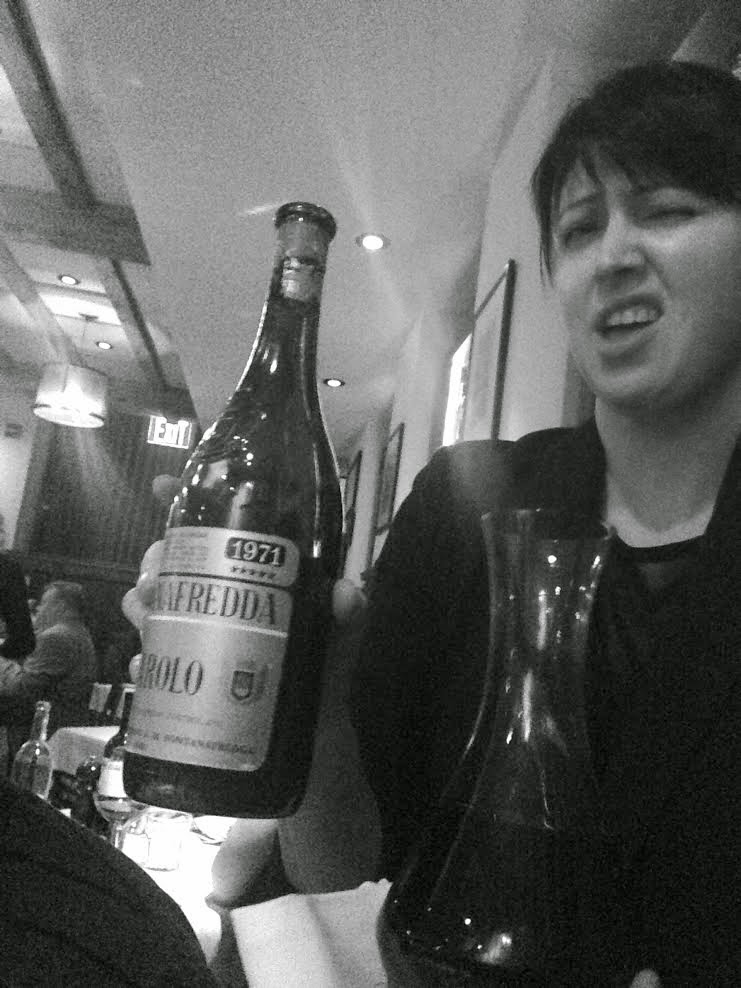
1971 Barolo Fontanafredda at Maialino NYC

Uncorking this 1971 Fontana Fredda Barolo this weekend at Maialino in New York City 
was a bit like opening a coffin in The Langhe and experiencing Nebbiolo zombies awakening from the dead to slowly climb into the glass.  


At first this wine smelled of rotten corpse, soil and maybe some tar for the sake of tradition.  Slowly opening into what reminded me of molded fruit loops covered in forest soil, and eventually into a more focused cherry with long classic Nebbiolo notes but still with a sense of rotting materials.  The acid was healthy as hell and the colour was notably a few more notches towards ruby than I expected.  I have had 80's Barbaresco and Barolo that were much more orange in colour.  But this was a fabulous and memorable wine and I believe we enjoyed the last bottle stocked at Maialino.


Monday, September 29, 2014

Nebbiolo of the day! Barolo Monvigliero by Castello di Verduno


After shuffling through some 30 to 40 wines at last weeks Domenico Valentino tasting in NYC at 
I Trulli restaurant I stopped everything the second this nebbiolo entered my glass.

Castello di Verduno makes some interesting, fun and easy drinking wines such as their bottlings of Pelaverga which include a bianco, a rosso and a sparkling rosato.  I have worked a lot with their Pelavergas and some Barbaresco as well but tasting their Barolo is a different story.  These expressions of Nebbiolo show that they aren't just about fun and games all the time but can put out a serious traditional styled bottle of Barolo that is absolutely delicious.

Castello di Verduno gets their name from the village of Verduno in the north most part of the Barolo DOCG right above La Morra.  Monvigliero, the grand cru of the area is known for its fine white marl, also known as "Marne di Sant' Agata''.  The soil produces age-worthy wines that are distinct and aromatically complex.  The 2007 Riserva (aged at least 30 months in botti grandi) was already so expressive with layers and layers of classic nebbiolo rose, cherry, liquorish and tar unfolding from the nose.  The tannins were very present but not overwhelming as many traditional 2007 Barolos are at this point in their life.

 A look from near the top of the CDV Monvigliero vineyard, captured courtesy of Levi Dalton

Wednesday, September 17, 2014

Magnum Mania for a 30th birthday celebration at Fort Tilden, NYC


The first saber of the day,  Billecart-Salmon Extra Brut NV in magnum

The gorgeous weather for the beginning of fall this month inspired me to bring everyone to the beach for a mid september birthday celebration.  I figured if I'm turning 30 I might as well make it that much more ridiculous and get everyone together on the idea of bringing magnums instead of normal format wine bottles.  Hey, we are already illegally drinking on the beach so lets just say fuck it and start sabering some big ass bottles of champy. 

The beach was Fort Tilden, an old military base, now hidden gem for beaches in New York City.  You really don't feel like you are just minutes from Brooklyn and New York. 

Liz Nicholson, Sommelier at Marea NYC, came in with the heavy hitter magnum of 2009 Leflaive ''Les Folatieres". First opened it was big, with strong fruit and oak present, but quickly morphed after we let it open up for a couple of hours into a much more mineral driven long drinking chardonnay.  Great stuff (And thanks to the police for the help).

Nick Leplant, moments before the sabering of a Ferrari magnum

Flawless Victory

Champagne of the day, shout out to James Obrien of Maialino for the Jacques Lassaigne Blanc de Blanc

Will Edwards of Elan, NYC with a sick magnum of Madiran 1996, made from 100% Tannat, delicious.


Thanks to Blake Noyes for the fly ass photography (far right kimono) and thanks to all these beautiful people!


Friday, August 22, 2014

Remembering Paolo Rapuzzi of Ronchi di Cialla


Pouring some Ribolla out for the lost.  

I Enjoyed a bottle of 2012 Ribolla Gialla from Ronchi di Cialla on a New York City beach earlier this week in memory of Paolo Rapuzzi,  the legendary producer of indigenous varieties of Friuli who passed away on August 13th.  This wine was showing a blazing minerality that day which I have watched open up over the past year since it's release.

Its amazing to watch the improvement of a wine over a period of time.  Something you can only really experience by working in a restaurant and tasting the same wine every single day.  Even a very simple pure Ribolla Gialla.

Thank you Paolo for letting the COF2011 crew into your family's home and opening some very memorable wines with us.  

Monday, May 5, 2014

Francesco Rinaldi, the meaning of ''Cannubbio''


During a reunion of friends and past Maialino wine team colleagues, we sampled from a beautiful roman menu and were fortunate to get served some memorable Nebbiolo from wine director, Jeff Kellogg.

After quenching our Champagne thirst we dove into two Nebbiolo's, a 1989 Francesco Rinaldi Barolo ''Cannubbio'', followed by a 1974 Oddero Barolo.

The '74 Oddero was drinking right around its peak, perhaps a touch past.  A bit thinner than the Rinaldi with an edgier acidity, tasting like a cigarette was put out in a shot of half cherry liquer half swamp water with a garnish of taleggio rind… you know in a delicious way though.

The Cannubbio from Rinaldi was one of the top five Nebbiolo's I have ever consumed no doubt.
Swampy cherries, with a gigantic liquorish bouquet, morphing into dark chocolate and tar, with a background of wilting roses.  Medium and long in body with still a large, youthful mid palate and gorgeous acidity that will allow this bad guy to age for at least 20 more years.  Drinking this wine was like riding an everlasting Nebbiolo wave.

What and where is Cannubbio?

After some research and a read through the Slowfood book,  ''a wine atlas of the Langhe'', I was surprised to find no easy answers regarding the intentions of ''Cannubbio'' on Rinaldi's Barolo labels.
I found three websites all providing different information about Cannubbio, Cannubi and Cannubi Boschis.

I Emailed over to the Francesco Rinaldi winery in Barolo to find out the deal, Paola responded as follows…

''Cannubbio was the old name used for this area (we found it in old documents and books). The modern name is Cannubi (on the maps starting with vintage 2010). Our old vintages are Barolo Cannubbio and our Barolo 2010 is Cannubi. We own nearly 2 hectars in Cannubi boschis  (the first part of the hill) and a small part in Cannubi (in the middle of the hill)


In the article Battling bureaucracy in BaroloJancis Robinson writes about the controversial change Giuseppe Rinaldi was forced into.  As of 2010 they can no longer label a Barolo ''Brunate-Le Coste'' because of two vineyards appearing on the label (It seems the 2010 will be labeled Brunate but will contain a blend of 15% Le-Coste grapes.) But as far as Cannubi goes, it seems to be okay to label a Barolo ''Cannubi'' even if its coming from the Cannubi Boschis (aka Monghisolfo) or other surrounding Cannubi sub zone vineyards. 

My friend Alfonso Cevola wrote on the current state of Cannubi itself a couple of years ago in an article To Cannubi or not to Cannubi? where he was coming up with at least 25 hectares of wine being labeled Cannubi even though it is an area of 15 hectares.

I guess this is all a classic example of how strange, unorganized and controversial Italian wine is.  I originally only wanted to share a few amazing wines I recently drank and the cannubbio gods took me on a never-ending tangent.  And I guess after three days of searching my original idea of ''sure, cannubbio is synonymous with cannubi right? hasn't really changed that much.

Happy Nebbiolo drinking


Tuesday, November 26, 2013

Missing the Piedmontese life in New York City.

During my Journey back to America from my South East Asia Adventures I received some photos from friends enjoying a Piedmontese life at Maialino in New York City.  Damn, these are two things that I will never feel bad about when returning to the city.

White Alba truffles and baseball, Maialino New York City.

Some 1971 Oddero Barolo is poured at Maialino to compliment the seasons white truffles.

Friday, April 26, 2013

Sunset in Bushwick followed by a Smokin' 2008 Gevrey-Chambertin at Boulud

 Above, That spring feeling in the air with a rooftop spritz, Bushwick, Brooklyn.


Later, we dined at Bar Boulud which was a pretty memorable charcuterie experience.  Also happened to open two memorable wines.

Starting with a 2011 Chablis from Domaine Pattes Loup, who practice organic viticulture, we were sold on it as soon as Sommelier Eduardo described it as fresh, and like tapping a glacier.  It really brought a whole new style of freshness and acidity to chablis that I have never tasted.

The second bottle made its way to our table in the form of Philippe Livera, Domaine Des Tilleuls, Gevrey-Chambertin, Clos Village 2008.  After this bottle I am sold on 2008 red Burgundy, for however long it lasts the wines at village level from this vintage are really expressing themselves.

In 2005 Damien Livera started estate bottling his wines.  Since the 1930's his grandfather was selling the wines to the Beaune negocient houses.

This bottle was full of sharp toasty notes; like an enticing burnt match that slowly morphed into dark tobacco, cherry and leather with amazing acidity. Really food friendly as well, gorgeous stuff this night.

Bar Boulud
1900 Broadway, New York, NY 10023

Wednesday, April 24, 2013

Chateau d'Arlay Corail, somewhere between rose' and orange


If you can find this wine here, it surely is one bad ass rose' to be drinking in the spring/summer time...
Chateau d'Arlay Corail, Cotes Du Jura,  a magical blend of 3 red and 2 white varieties, Pinot Noir, Trousseau and Poulsard, as well as Savignin and Chardonnay, then aged in oak barrels for three years.  This wine doesnt give you everything its got on the first sip, instead it slowly releases notes of dried rose petals, hibiscus, turpentine, alpine herbs, with constant subtle floral aromas and steady acidity.

Friday, April 19, 2013

Pies and Thighs, Brooklyn.

Above, the epic Chicken Biscuit, with hot sauce and honey butter... Loch Ness?


What happens to be a very popular restaurant practically in my backyard, I have only been to Pies and Thighs twice.  On the weekends there is always a swarm of people outside with an hour or two of waiting ahead of them.  I stopped in on a Friday afternoon though for a much calmer and enjoyable experience than the Saturday/Sunday NYC brunch madness that i wish to not take part in.

The food is southern, delicious, and affordable.  Pictured below: Chicken Biscuit, Rob Evans on a Biscuit (with sausage gravy), Fried Pickles, Raised Donut, Iced Coffee and a really satisfying Mimosa.


166 S.4TH STREET (@DRIGGS)
BROOKLYN NY 11211
(347-529-6090)

Campania: The varieties your mother never taught you about.

A little research put together for a lesser known grapes of Campania wine education class at Maialino NYC last week.  Included are most of the rarer grapes, but also those most relevant to the enomatic program at the restaurant.

The DOC Zones of Campania (Vino Italiano)

1 Taurasi (DOCG) 2 Aglianico del Taburno (DOCG) 3 Aversa 4 Campi Flegrei 5 Capri 6 Castel San Lorenzo 7 Cilento 8 Costa D'Amalfi 9 Falerno del Massico 10 Fiano di Avellino (DOCG) 11 Galluccio 12 Greco di Tufo (DOCG) 13 Guardia Sanframondi/Guardiolo 14 Ischia 15 Penisola Sorrentina 16 Sannio 17 Sant'Agata dei Goti 18 Solopaca 19 Vesuvio

Vitigni Rossi:
Pallagrello Nero
Casavecchia
Piedirosso
Olivella (Sciascinoso)
Marsigliese
Guarnaccia (Grenache)


Vitigni Bianchi:
Pallagrello Bianco
Verdeca
Coda di Volpe
Biancolella
Forastera (Uva dell'Isola)

Pallagrello Bianco - Thought to be Coda di Volpe for years, but Pallagrello Bianco produces a wine of much greater complexity than Coda di Volpe.  Often seen as a varietal wine which are rich yet soft, with notes of apricot, peach, honey, wax, almond and vanilla.

Coda di Volpe – Meaning foxes tail, produces wines golden yellow in colour.  The grape doesn’t produce a ton of acidity, which is why it shows so well in Vesuvius volcanic soils.  Volcanic soils usually impart a higher acidity to grapes grown in them.  Wines tend to be Fruity, citrus, tropical and sometimes spicy.
DOC: Irpinia, Sannio, Solopaco, Lacryma Christi di Vesuvio 

Biancolella- Likely to be of Greek origin, it find's it's purest expression on the island of Ischia off of the Bay of Naples. It usually produces light and fruity wines with hints of almonds.
DOC: Costa d'Amalfi, Campi Flegrei, Penisola Sorrentina

Forastera- Light and fresh, made to be drunk in it's youth.  Wines have notes of stone fruits, peach, apricot, sage, juniper and almonds.
DOC: Ischia

Verdeca – Probably of Greek origin and related to verdicchio, it was once used in making quality vermouths before it fell out of fashion.  The grape now shows it’s best in the region of Puglia as a varietal wine. Verdeca is used in Campania mainly as a blending grape. Wines range from neutral and herbal to aromatic and citrus driven.
DOC: Lacryma Christi di Vesuvio 

------------------------------------------------------------------


Olivella/Sciascinoso - Very closely related to eachother and sometimes synonymous. Clusters and berries are large and make wines very colorful, fresh and made to be drunk within a year or so.
DOC: Sannio, Lacryma Christi di Vesuvio, Gragnano, Lettere

Pallagrello Nero- Indigenous to the Province of Caserta, which gets its name from the small, ball-like form of the grapes which come in small bunches.  One of the very few Varieties that have both a red and white species. The Rosso is of High quality, with good ageing capabilities, thick skinned but soft tannins.  Notes of blackberry, plum, and pepper.  
Terre Del Volturno IGT 

The grape variety Casavecchia, which means “old house” in Italian, is a genetic cousin of the grape Trebulanum—a variety that was widely consumed in ancient Rome. The grape all but disappeared after the fall of the empire and was rediscovered at the beginning of the last century. A single vine was discovered near an abandoned house in the Caserta area and the vine was so old, the arm span of one person was not enough to embrace its trunk. Cuttings from that “mother plant” gave a second wind to the variety and today it’s a popular choice among farmers. Casavecchia is appreciated for its inky tannic structure and intense blackberry and cherry bouquet that pairs with sweet meat like roasted pork.
*Terre del Principe, Casavecchia

Marsigliese- A lost variety, recuperated alone by the Di Meo Family of La Sibilla who produce the Marsiliano. (70% marsigliese 20% olivella 10% piedirosso)  The wine produced here tends to be dark ruby to purple, full bodied, with bold dark berry and cherry fruit and a touch of pepper and/or smoke.
*La Sibilla, Marsiliano

Piedirosso- Also known as Palombina (little dove), and on Ischia called Pere’e Pallummo (doves feet) in the local dialect. The names reference the three rust colored stems that resemble a doves feet. It produces wines deep ruby in color, med-full bodied, soft tannins with plum, cherry and wild berry fruit. Minerally and even salty characteristics sometimes can be attributed to the volcanic soils in which the grape thrives.
*Cantine Farro, Campi Flegrei

------------------------------------------------------------------

Lacryma Christi di Vesuvio (Tears of Christ) 
Altitude: 200-350 Meters
Bianco- Permitted Grapes: Coda di Volpe bianca e/o Verdeca (min 80%), Falanghina e/o Greco (max 20%)
Notes: intense aromas, reminiscent of Vesuvian broom evergreens with fruit notes of very mature quince and yellow peaches.
Rosso- Permitted Grapes: Piedirosso e/o Sciascinoso (min 80%), Aglianico (max 20%)
Notes: firm body, fruity, and sometimes takes on herbal qualities

Campi Flegrei DOC
Winemaking here can be traced back to 700BC.
Rosso- Piedirosso
Bianco- Falanghina, Biancolella

Ischia DOC
Located on the Largest island off of the Bay of Naples, this DOC is best known for its fresh, subtly floral and approachable whites (Biancolella and Forestera) to pair with the local seafood of la cucina napoletana.  The vine heritage dates back to 700 BC, and In 1966 Ischia became Italy's 2nd DOC. Being a small island the vineyards are mainly planted on terraces. The altitude is around 180 Meters and the vines benefit from the cool sea breeze.  The soils here are well drained and volcanic (tufo verde or green tufa).

Terre Del Volturno IGT 
Located right outside of Caserta, IGT created in 1995, using both Pallagrello Nero and Bianco, Casavecchia and Aglianico.

Gragnano and Lettere DOC (Penisola Sorrentina)
(Main grapes: Sciascinoso, Aglianico, Piedirosso)
Gragnano and it's lesser known little brother Lettere make up subzones of the Penisola Sorrentina. They are easy drinking sparkling reds similar in style to some Lambrusco's.  As Lambrusco goes magically well with Salumi in Emilia Romagna, Gragnano and Lettere are made to be paired with simple Neapolitan cuisine such as a classic Pizza Margherita of Campania or even a Panuozzo if you are lucky...  Just ask Ms. Ambrosio.


Thursday, April 18, 2013

Pour that Fernet Branca over your dessert


Experimenting with Fernet Branca over dessert...
Vanilla Ice cream
Cooked down strawberries
Bourbon and maple syrup whipped cream
Fernet Branca drizzled over the top

Monday, March 25, 2013

Bunga Bunga with 1996 Corton-Charlemagne


Last night my friend Giuseppe Locascio invited me into his apartment for a pasta con le sarde dinner.  When I arrived Iacopo di Teodoro (below) was tossing together a classic Puntarelle with anchovy and shortly after we had guzzled down some Sauvignon from the Alto-Adige Iacopo unleashed a 1996 Corton-Charlemagne from Bonneau du Martray.  This Domaine holds only Grand Cru vineyads on the Corton hill. 9.5 hectares of Corton-Charlemagne as well as some Pinot Noir in the Grand Cru of Corton.

The wine had been open for about an hour and by the time we got to it (at slightly colder than cellar temperature), it was super expressive, singing to all of us.  Sometimes when you are poured a magical wine that is aged properly and fully expressing its true character, you cant help but to smell it over and over.  At one point I stopped sipping this wine and just continued sniffing the magical aromas coming from the glass.

For shits I was browsing the cellartracker.com notes and most reviews ripped apart this wine for being over the hill and/or oxidized which was not in any form the case here.
This '96 Corton-Charlemagne had the classic deep golden colour of aged chardonnay from Burgundy and bursted with scents of deep caramel, almonds, candied citrus and held an impressive weight, acidity and minerality on the palate.
Cheers Iacopo!


An overall classic Italian dinner in New York City with the New York Italian connection.  Of course the conversation drifted from wine philosophy to the absurdity of recent Italian politics and it brought to mind the Bunga Bunga Ford advertisement that just went down in India.


Thursday, January 24, 2013

Fiorano! Turning the impossible into a wine by the glass

Above, Fiorano labels, the Semillon to the left and the Bianco (Mavasia di Candia) to the right.

There are a few articles floating around about Prince Alberico Boncompagni Ludovisi and his magical wines.  When the prince took over the estate just outside of Rome in 1946 he replanted the vineyard with Bordeaux grapes (with the exception of Malvasia), a practice way ahead of it's time.  After the 1995 vintage he ripped up all of his vineyards to protect his name and keep anyone from making his wines.  

Up until the year 2000, 14,000 bottles laid in the cellar covered in the mythical white mold. At that point their responsibility was passed onto Italian wine writer, Luigi Veronelli.  They were then dispersed accordingly and 13 years later they have found their way onto the wine by the glass program at Maialino in New York City.


The four bottlings of Fiorano we are currently pouring on the Lazio Enomatic program:


Age-worthy Semillon in Lazio?

Each of the bottles are interesting in their own way.  The Semillon's are quite deep and complex wines, while the Malvasia's are a little brighter and hit you with a salty acidity right away.  The 1988 Semillon was the bottle everyone seemed to agree on as being the most complex and most suitable for those 25 years of cellar aging, tasting of deep caramel notes, nuts, spices and dried flowers.  The 1995 Malvasia was incredible as well, prancing on the palate with a lightness and it tasted like ocean water, burnt oranges and dried flowers.  One thing to note is that during the tasting every second bottle we opened tasted so differently from the first, wether it was slightly more or less oxidized or just it's own personality that it carried. This is really a case of intense bottle variation and the wine you taste upon opening will be a whole other beast once 15 minutes passes.

However, this still leave's us with the obvious question: Why and how is a 25 year old Semillon from Lazio drinking so damn fine right now? Semillon as a variety seems to only prove itself in Bordeaux and Australia's Hunter Valley.  Even in Bordeaux it is still blended with Sauvignon Blanc which plays a crucial role in the finished product.

Jancis Robinson (Vines, Grapes and Wines) writes of Semillon as ''A very odd grape indeed. It is grown, often extensively, all over the world.  In most of these vineyards it sits around sullenly like an overweight schoolgirl, showing awkward fatness or just plain dullness in the wines it produces.''

The secret must lie somewhere between the soil, the magical white mold, the large mold covered barrels used year after year and the Prince's love for his vineyard and wines.  It is quite an honor to be talking about and pouring these wines in a Roman Restaurant in 2013.  These wines will never be made again, and someday soon enough won't ever be seen or tasted again.  A magical moment in wine history indeed.


Maialino Wine Director Liz Nicholson joined by Prince Alberico's children from Lazio.

Monday, December 10, 2012

Lettere Doc to Sinister Pop on the Upper East Side


Lettere DOC, another easy drinking sparkling red if your looking to explore beyond Lambrusco.  Lettere is a small town southeast of Naples and right next to Gragnano, the other friendly sparkling wine from Campania. Lettere joined the DOC club in 1994 and is required to use at least 40% Piedirosso with a blend of other grapes like Sciacinoso and Aglianico.  The Paolo Palumbo Lettere is farmed from five hectares with an annual production of 35,000 bottles using the Charmat method.

After a classic lunch at San Matteo Pizza and Espresso Bar, I ended up at the Whitney Museum also on the upper east side.  Wine and art pairings, I've always liked this idea...
Friday's you can enter The Whitney with just a small donation, below are two shots from the Sinister Pop exhibit now in action.

Before and After, 1961. Andy Warhol

Freezer Still Life, 1970-1973. William Eggleston

Friday, November 30, 2012

Eva Fricke, and a stop into Terroir for a much needed trocken fix

A handful of Riesling grapes in the vineyards of Eva Fricke in the Rheingau.  September 2012

One of the the coolest parts about traveling for wine is going back and referencing some of the shit you learned weeks or months after you have returned from a trip.  When you are visiting 3 to 4 producers a day for a week straight, certain aspects begin to blend together.  For me the most rewarding part is the day you drink that same wine in a different country or setting and are able to look back at your notes and experiences.

Stopping into Terroir in Murray Hill this week, I found myself reaching in desperation for a bottle of Eva Fricke to satisfy my thirst for that salty acidity I got so used to in Trocken Riesling's tasted in Germany last September.


A pleasant surprise to find Riesling hero Paul Grieco pouring wines himself at the Murray Hill Terroir.   Paul is a cool dude, even when he forces me out of my comfort zone and denies me of any wine Italian.

We ordered a bottle of 2011 Eva Fricke Lorch (blend of two single vineyards), an amazing example of those salty minerally notes you can find in a finely made trocken Riesling.  This was actually the first Riesling I have tasted since September and at least I got back on track with style.

A lineup of Eva's wines that she brought to our dinner at Adler Wirstchaft in Hattenheim.

Eva Fricke was the cellarmaster at Leitz before starting her own line in 2006.  She has a fresh view on winemaking and is quite in touch with nature.  Fricke wines are made using mainly indigenous yeasts, some champagne yeasts if necessary but always neutral non aromatic.  The wines age on the lees and there is some considerable skin contact, at times up to 48 hours.

Eva finds that in the Rheingau, vineyards with more quartz will produce mineral driven wines, while the vineyards with grey slate have a rounder creamier characteristic in their wines.

Talia Baiocchi with Eva Fricke steady sippin' in the Rheingau.

Christina with a glowing glass of Riesling.  Photo: Brunellos Have More Fun 

 Tasting the 2011 Lorch in the vineyards with Eva Fricke.  Photo: Brunellos Have More Fun


A little Riesling video I came across from Stuart Pigott featuring Paul Grieco.

Wednesday, November 21, 2012

2003 Bartolo Mascarello and white truffles


While tasting a flight of Nebbiolo based wines tonight at Maialino, I finally went for it and ordered some white truffles. House made Tonnarelli done in butter, a touch of Parmigiano Reggiano and finished with the sacred whites truffles from Alba shaved gently over the top.
Ragazzi, che meraviglia...

I saved the Bartolo Mascarello tasting for the arrival of the white truffles.  The 2003 we are currently pouring by the glass at Maialino, along with about 15 other amazing Nebbiolo based wines on the Enomatic Nebbiolo Bar.  Bartolo for $140 a bottle in a NYC restaurant is quite a steal!  This wine is very aromatic right off the bat with classic roses, earth, tar and liquorish.  The acidity is still brilliant and it is a no-brainer when it comes to a pairing with tartufi bianchi di Alba.

But 2003?  Yes an overall shit year, being overly hot and resulting in scorched vineyards, but true producers were able to put together some fine wines which are drinking gorgeously right now at only 9 years out.  Where I have tasted some B. Mascarello from finer and more talked about vintages such as 97, 98 and 2000 they can go through unfortunate stages where they are completely closed and inexpressive.

This type of experience can definitely make one rethink the whole process of selecting a vintage, especially in a restaurant setting where sometimes the underdog vintage will triumph in the end.

Friday, November 16, 2012

Thursday, celebrating Beaujolais


Yesterday (November 15th) brought us the celebrated Beaujolais Nouveau Day and while tasting a handful of Beaujolais Cru's I found myself fascinated by the above bottling of Domaine des Billards Saint-Amour 2009.  Belonging to the Barbet and Teissier families natural/organic farming is practiced in the vineyards as well as traditional winemaking.

The wine has some nice bright fruit aromas jumping out of the glass at first, but on the palate a whole different story of complexity.  Luscious red fruits and cherry notes are balanced by a wonderful minerality and earthiness.  The most focused Beaujolais I have tasted in a while and it really stood out from the rest.  You can find this wine through David Bowler imports for the U.S. market.


A Beaujolais Slinger at L'express on Park ave and 20th st. New York.

Friday, August 31, 2012

On the road from New York City to Massachusetts, and a run into Susucaru!

Last day on the beach for the summer of 2012. Fort Tilden, New York.
 
6:15 am Sunrise. Richmond, Massachusetts. 
 

Enjoyed a relaxing Berkshire style picnic, with Frank Cornelissen's Susucaru Etna Rosato... Wine made the old fashioned way.  This is a bad mother fucker with heaps of gunk and unfiltered delicious juice.  Mineral, full bodied with Notes of sour cherry, rhubarb, kombucha and thick juicy tannins. 

The red and white grapes going into this wine co-ferment for 45 days on the skins.  The result is an incredible rose' if your into this style.  I like the way K&L wine merchants write, "This is the kind of wine that if you have to ask about you wont like it and shouldnt buy it, it's really different."

Staying in the Berkshires a few days before heading to Milano, and then on the Wine Trail in Germany...